SynPlanner#

SynPlanner is a comprehensive tool for reaction data curation, rule extraction, retrosynthetic model training, and retrosynthetic planning.
It processes various reaction data sources to build a ready-to-use retrosynthetic planner.
SynPlanner includes modules for atom-to-atom mapping, reaction curation, standardization, and rule extraction,
ensuring reproducibility from initial data to trained retrosynthetic models.
SynPlanner use cases#
1. Curating/cleaning reaction data
SynPlanner provides embedded enhanced reaction data curation protocols,
including reaction atom mapping, standardization, and filtering, which can be used independently.
This curated data and pipelines can be used in other reaction informatics applications or for CASP tool development.
More details can be found in data curation.
2. Extracting reaction rules from the reaction database
SynPlanner incorporates the original module for reaction rule extraction from reaction data.
The protocol of reaction rule extraction is flexible and allows balancing between the generality and specificity of reaction rules
depending on the task.
More details can be found in reaction rules extraction.
3. Building custom retrosynthetic planners
SynPlanner delivers various configurations of reaction rule extraction and a comprehensive pipeline
for preparing retrosynthetic models (policy and value networks) and building ready-to-use retro-synthetic planners.
This makes it perfect for retrosynthetic planning using custom or private re-action data, specific reaction databases,
or specific types of chemistry.
SynPlanner Pipeline#
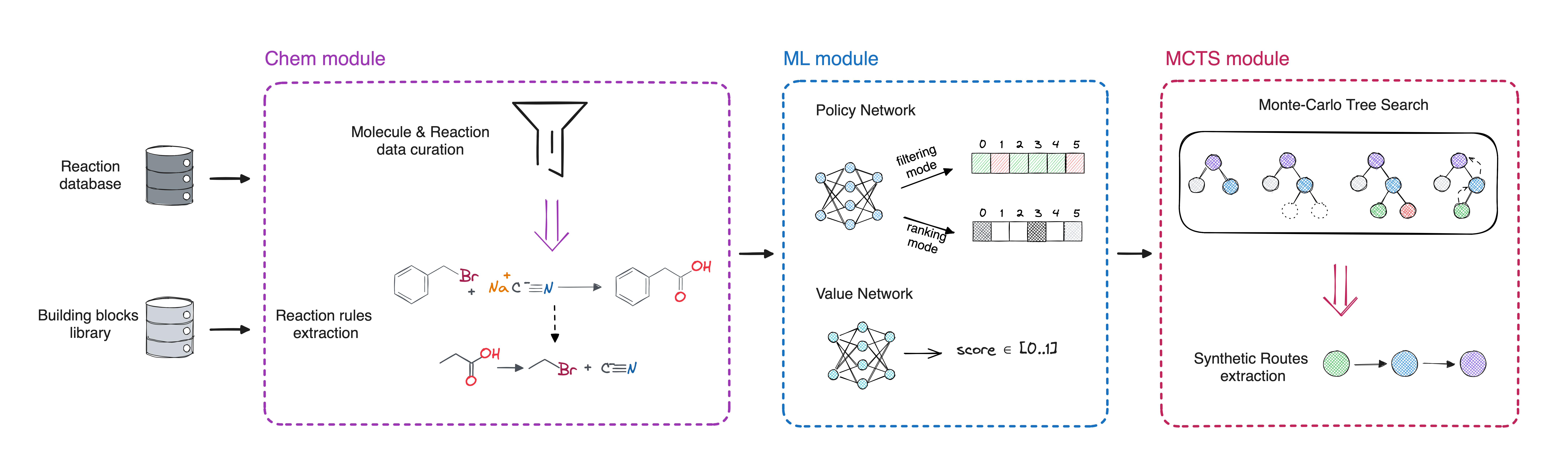
SynPlanner includes modules for reaction data curation, reaction rules extraction, and retrosynthetic planning using the
Monte-Carlo Tree Search (MCTS) algorithm with neural networks for node expansion and evaluation.
The main steps of this pipeline are listed below.
Reaction data curation is a necessary step, including reaction standardization and filtration. See the details in data curation tutorial.
Reaction rules extraction should be done from the high-quality reaction data prepared by the data curation steps listed above. See the details in reaction rules extraction tutorial.
Policy network training is needed for node expansion in the tree search algorithm. See the details in ranking policy training tutorial.
Retrosynthetic planning is done after preparing the reaction rules and training the retrosynthetic models. See the details in retrosynthetic planning tutorial.
Tip
If you want to run retrosynthetic planning, you can download the data we used in our paper. See more in section Data.